That’s why it’s important to build a website that is flexible and customisable, allowing it to grow and adapt alongside your business rather than quickly falling behind.
At Cargo, we build websites with our clients in mind to ensure the design and development process is smooth, but also to maximise the potential of their site post-launch. Each element is designed and developed with customisation possibilities in mind, allowing clients to change colours or add imagery when necessary, with our development team working closely with our designers to ensure a visually appealling and web-friendly approach to the build process.
Our platform of choice is WordPress, the world’s most widely used content management system (CMS). Since its launch in 2003, WordPress has grown from a simple blogging platform into a powerful and flexible foundation for websites of all sizes.
WordPress powers 43-44% of all websites.*
*As of April 17, 2025, 43.4% of the websites on the internet run on WordPress, according to W3Techs
One of the key reasons for the success of WordPress is that the platform is open-source, meaning its code is freely available and continuously improved by a global community of developers and contributors. This approach has helped the platform evolve into a reliable, secure and adaptable solution for developers.
Beyond its technical strengths, WordPress is designed with both developers and content managers in mind. Its flexibility allows us to build customised CMS experiences that are tailored for each client we work with. We have produced custom CMS experiences for clients including NHC Procurement, ID Unlimited (formerly Elms) and the Alan Shearer Foundation.
In 2018, WordPress introduced a new editing experience – the Gutenberg Editor. Instead of relying on a single text editor, Gutenberg uses a block-based system, where pages are built from individual components, or blocks.
This approach makes creating and editing pages far more visual and intuitive. Content is organised into clear sections, allowing designers and developers to see how a page is structured whilst editing the page. Blocks can be added, rearranged and updated easily, giving more control over how the website content is presented.
However, the default blocks are designed to be general-purpose. This is where Advanced Custom Fields becomes an important factor in the build stage of a website.

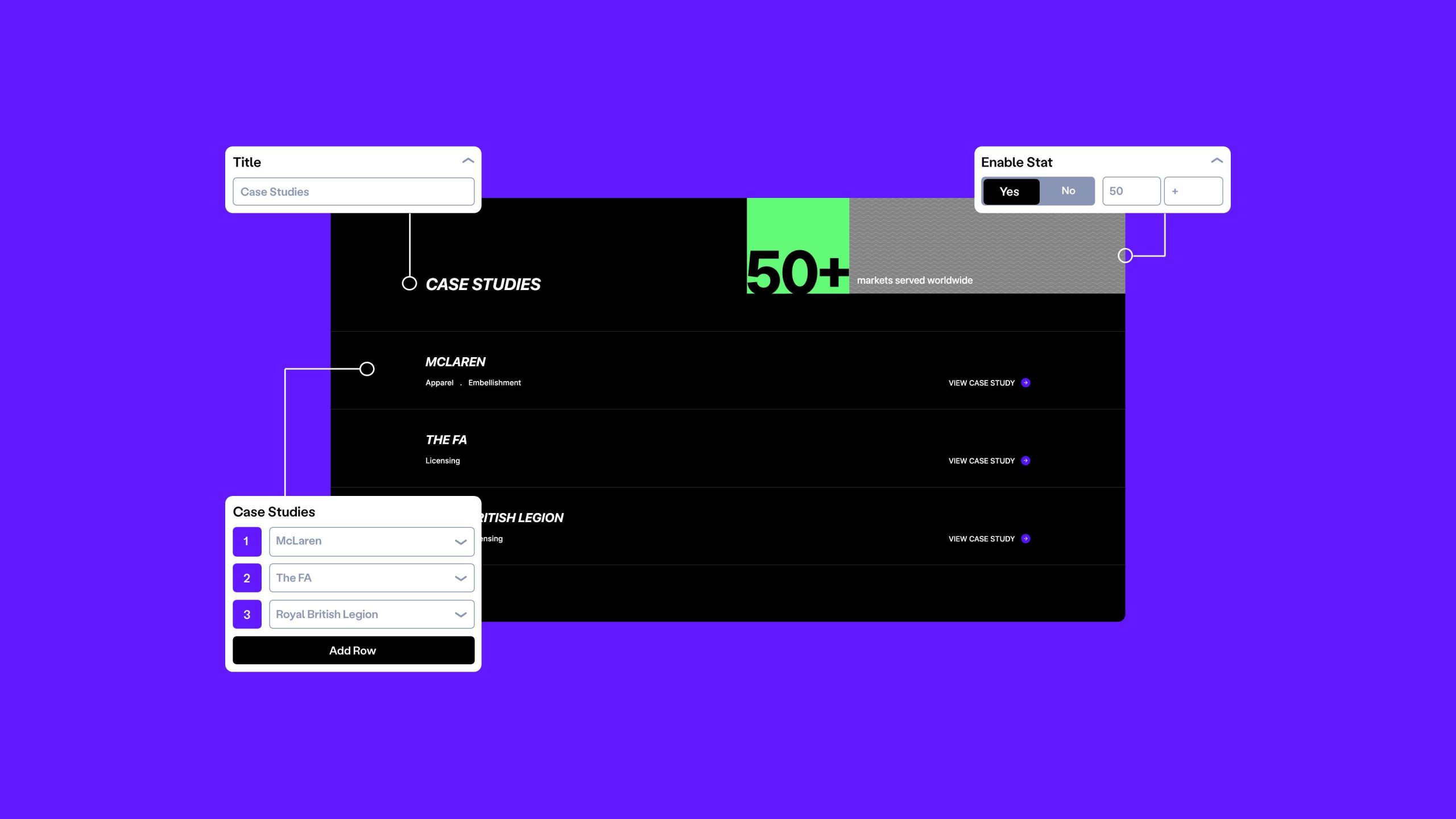
While Gutenberg provides a modern, block based editing experience, it was designed with a set for general purpose that aren’t tailored to the unique needs of many businesses. We take Gutenberg further by building bespoke ACF-powered blocks that are fully bespoke for each client.
These ACF-powered blocks form the building blocks of your website, Every site we create receives its own custom set of sections, tailored specifically to the client’s content and design needs, which are discussed and agreed on during the design phases of a build project. Common examples of these blocks include hero sections, feature grids, testimonials, and call-to-action blocks.
To ensure our clients have the best possible editing experience, we also develop our own bespoke ACF field types. These custom fields make it simple to update and manage each section, ensuring every block we create is intuitive, flexible, and perfectly tailored to the client’s content needs.
Building scalable digital experiences is important to us and we combine UX design, modular design and getting the CMS right dependent on a client’s needs. This plays a big role in buidling a digital experience that works hard for you now, but will work harder as your brand grows.